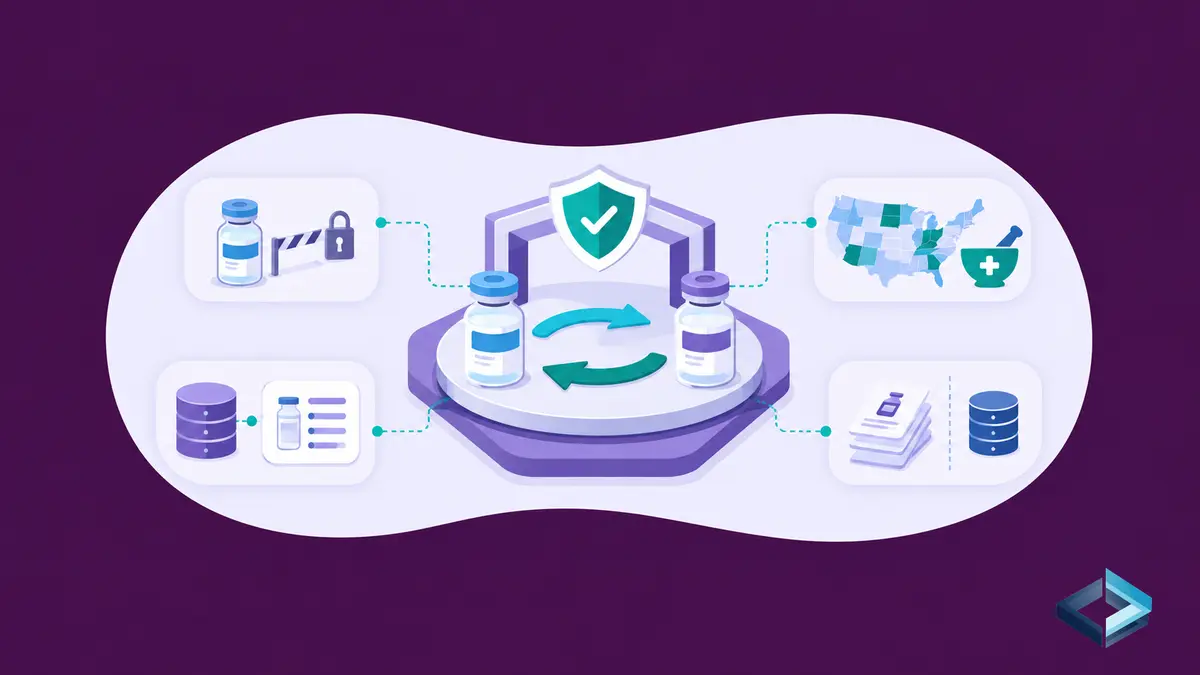
Interchangeable Biosimilars: How to Analyze Pharmacy-Level Substitution Using the Purple Book
Interchangeable biosimilars are an important source of regulatory and utilization intelligence for specialty pharmacy directors, payers, and healthcare data analysts. The FDA’s Purple Book can identify which biological products are licensed as biosimilars and which carry an explicit interchangeability determination. It cannot, however, show how often those products are dispensed, substituted, or paid for in real-world practice.
That distinction is essential. A sound analysis begins with the regulatory record, then connects it to pharmacy and medical claims data to measure adoption, substitution, access, and spending.
Table of contents
- What the Purple Book Contains
- Biosimilar and Interchangeable Are Different Designations
- What Pharmacy-Level Substitution Means
- How to Read an FDA Interchangeable Biosimilar Record
- Why the Purple Book Cannot Measure Utilization by Itself
- A Data Model for Interchangeability Analysis
- Designing a Pharmacy Substitution Study
- Common Analytical Errors
- Using QOPE for Purple Book Intelligence
- Conclusion
- Sources
What the Purple Book Contains
The Purple Book is the FDA’s database of licensed biological products. It includes products regulated by the Center for Drug Evaluation and Research (CDER), including reference products, biosimilars, and interchangeable biosimilars. It also includes numerous biological products regulated by the Center for Biologics Evaluation and Research (CBER), such as vaccines, allergenic products, cellular therapies, gene therapies, and hematologic products.
Product records can be searched by proprietary name or nonproprietary name. A product results page groups biological products that share a core name, allowing users to review related reference, biosimilar, interchangeable, and other biological products. Records include identifying information such as the product name, BLA number, and approval pathway.
For analysts, the Purple Book is best understood as an authoritative regulatory database—not a claims or dispensing-volume dataset. It documents FDA licensing and regulatory designations. It does not report prescription fills, units dispensed, payer reimbursement, commercial sales, market share rankings, or pharmacy-level substitution events.
This makes the Purple Book a foundation for classification and cohort construction, rather than a standalone source for utilization measurement. For a broader orientation, see the FDA Purple Book Guide.
Biosimilar and Interchangeable Are Different Designations
A biosimilar is a biological product that has been evaluated under the abbreviated pathway in section 351(k) of the Public Health Service (PHS) Act and determined to be highly similar to an FDA-approved reference product, with no clinically meaningful differences in safety or effectiveness under the approved conditions of use.
Interchangeability is a separate regulatory determination. Under section 351(k)(4) of the PHS Act, an interchangeable product must meet additional statutory criteria beyond biosimilarity. Under section 351(k)(4)(A), the product must be expected to produce the same clinical result as the reference product in any given patient. Furthermore, under section 351(k)(4)(B), for products administered more than once, the risk in terms of safety or diminished efficacy associated with alternating or switching between the biological product and reference product must not be greater than the risk of using the reference product without such alternation or switching (the statutory switching standard).
Crucially, meeting this statutory switching standard does not mandate a dedicated switching study. While early regulatory implementation commonly relied on dedicated multi-switch clinical trials, FDA’s scientific approach has evolved. In its June 2024 draft guidance update (Considerations in Demonstrating Interchangeability to a Reference Product: Update), the FDA clarified that applicants may support the statutory switching standard through existing comparative analytical and clinical data, stating that the agency now generally does not recommend dedicated switching studies. In fact, 9 of the first 13 interchangeable biosimilars approved by the FDA were licensed without dedicated switching-study clinical trials.
The practical consequence is important: interchangeability is a regulatory designation related to substitution and statutory switching criteria. It should not be interpreted as evidence that an interchangeable biosimilar has higher clinical efficacy or safety than a non-interchangeable biosimilar. Both designations reflect FDA regulatory conclusions, but they answer different questions.
A non-interchangeable biosimilar may still be prescribed and used in clinical care. The interchangeability designation specifically addresses the legal and regulatory framework for pharmacy-level substitution, subject to applicable state law.
What Pharmacy-Level Substitution Means
Interchangeable biosimilars can be substituted at the pharmacy level without prescriber intervention, subject to state pharmacy laws. This is the central operational distinction between an interchangeable biosimilar and a biosimilar without that designation.
The phrase “without prescriber intervention” describes the federal framework for substitution. State pharmacy laws determine whether and how automatic substitution operates in a particular jurisdiction. States may establish requirements involving notification, recordkeeping, patient communication, consent, product availability, or other conditions.
Consequently, an FDA interchangeable designation does not mean that substitution occurs automatically in every state or every dispensing setting. Pharmacists cannot substitute biosimilars in states that prohibit automatic substitution. Analysts should therefore avoid treating the Purple Book designation as proof that a substitution event occurred.
The regulatory record can identify whether a product is eligible for consideration under the federal interchangeability framework. It cannot establish:
- Whether a pharmacist substituted the product
- Whether the prescriber directed the product
- Whether the patient received the reference product or a biosimilar
- Whether state-specific requirements were satisfied
- Whether a claim reflects a new start, continuation, or switch
- Whether the product was administered under the medical benefit rather than dispensed under the pharmacy benefit
These questions require additional data sources and careful interpretation.
How to Read an FDA Interchangeable Biosimilar Record
The Purple Book displays explicit interchangeability determinations for licensed 351(k) biologics. This is a critical feature for building a reliable interchangeable biosimilar list.
When reviewing a record, analysts should first confirm the regulatory pathway. A 351(k) designation identifies a product licensed through the biosimilar pathway. The record should then be assessed for its interchangeability status. In the Purple Book, products may be identified as “Interchangeable” alongside relevant product and BLA information.
A basic record-level workflow includes:
- Identify the biological product. Capture the proprietary name, nonproprietary name, dosage form, route, and strength where available.
- Confirm the BLA number. Use the BLA as a stable regulatory identifier for linking and deduplication.
- Confirm the approval pathway. Distinguish 351(k) products from products licensed under section 351(a).
- Capture the interchangeability designation. Do not infer interchangeability from the product name or from biosimilar status alone.
- Identify the reference product relationship. Group the biosimilar or interchangeable product with its reference product for comparative analysis.
- Track regulatory updates. Designations and product records can change over time, so preserve effective dates or download dates in analytical datasets.
The database may display repeated entries or multiple presentations associated with a product. Analysts should define whether the unit of analysis is the product, BLA, presentation, National Drug Code (NDC), or claimable package. This decision affects deduplication and downstream utilization measurement.
The Interchangeable Biosimilars Lookup provides a focused way to review these records and identify products carrying the designation.
Why the Purple Book Cannot Measure Utilization by Itself
Regulatory status and real-world utilization are different dimensions of healthcare data.
The Purple Book can answer questions such as:
- Which products are licensed as biosimilars?
- Which 351(k) products have an explicit interchangeable designation?
- Which reference product is associated with a biosimilar?
- What BLA identifies the licensed product?
- When was a product included in the regulatory database?
It cannot answer utilization questions such as:
- How many prescriptions were filled?
- What proportion of patients received an interchangeable biosimilar?
- How frequently did a pharmacy substitute one product for another?
- What was the product’s paid amount or allowed amount?
- Which payer, provider, pharmacy, or region had the highest use?
- How did utilization change after launch or designation?
The Purple Book does not track commercial sales or market share rankings. It is not a substitute for prescription claims, medical claims, invoice data, wholesaler data, or formulary records.
This limitation is not a weakness. It reflects the database’s purpose: documenting licensed biological products and their regulatory relationships. The analytical value comes from combining that authoritative classification with datasets that capture care delivery and payment.
A Data Model for Interchangeability Analysis
A robust analysis generally requires three layers: regulatory data, product identity data, and utilization data.
1. Regulatory layer
Use Purple Book records to create a product master containing:
- Product name
- Nonproprietary name
- BLA number
- Approval pathway
- Reference product
- Biosimilar status
- Interchangeability status
- Regulatory date fields
- Source and retrieval date
This layer establishes what the FDA has determined about the product.
2. Product identity layer
Claims often use NDCs, Healthcare Common Procedure Coding System (HCPCS) codes, revenue codes, or internal payer product identifiers rather than BLA numbers. Build a crosswalk connecting the Purple Book product to the identifiers used in claims.
Depending on the product and benefit channel, the crosswalk may include:
- NDC and package-level identifiers
- HCPCS codes
- J-codes or other medical billing codes
- Product-specific internal identifiers
- Manufacturer and labeler information
- Strength, dosage form, and route
The crosswalk should be versioned. Product codes, package configurations, and billing practices can change, and a single regulatory product may have multiple claimable presentations.
3. Utilization layer
Measuring real-world utilization requires combining Purple Book regulatory designations with medical and pharmacy claims datasets. Pharmacy claims may capture products dispensed through retail, specialty, or mail-order channels. Medical claims may capture biologics administered in outpatient facilities, physician offices, hospital departments, or other settings.
A combined dataset can support analyses of:
- Patient starts and switches
- Product mix by payer or plan
- Reference-to-biosimilar transitions
- Interchangeable versus non-interchangeable biosimilar use
- Pharmacy and provider patterns
- Site-of-care differences
- Allowed amounts and patient cost sharing
- Persistence and discontinuation
- Utilization before and after regulatory milestones
Because claims data generally identify the product billed or dispensed—not the pharmacist’s intent—analysts should describe results precisely. A claim showing an interchangeable biosimilar indicates use of that product; it does not necessarily prove that a pharmacy-level substitution occurred.
Designing a Pharmacy Substitution Study
A pharmacy substitution study should begin by defining the estimand. Possible objectives include measuring interchangeable product uptake, estimating switching from a reference product, or identifying dispensing patterns consistent with substitution.
A practical study design may include the following steps.
Define the population and index date
Specify the therapeutic area, age range, coverage type, benefit channel, and enrollment requirements. The index date might be the first observed product claim, the first claim after an interchangeable designation, or the date of a product switch.
Build product cohorts
Classify products using the Purple Book designation, then link each product to claim identifiers. Keep reference products, biosimilars, interchangeable biosimilars, and other related biological products in separate categories.
Establish baseline treatment
Use a lookback period to identify the patient’s prior product. This helps distinguish new treatment initiation from switching. A patient receiving an interchangeable biosimilar after a reference product may represent a switch, but claims alone may not reveal whether the change was initiated by a prescriber, payer policy, pharmacy process, or patient preference.
Measure switching and persistence
Define a switch using a clinically and operationally appropriate gap or overlap rule. Examine whether patients remain on the new product, return to the reference product, or move to another biosimilar.
Stratify by jurisdiction and channel
State pharmacy laws matter when interpreting pharmacy-level substitution. Stratify results by state and distinguish pharmacy-benefit dispensing from medical-benefit administration. A product’s interchangeability designation may be relevant to pharmacy substitution, while medical-benefit use may involve different ordering and billing workflows.
Report uncertainty and limitations
Results should identify data completeness, enrollment continuity, coding limitations, and the inability to observe pharmacist intent. Avoid presenting product uptake as a direct count of automatic substitutions unless the dataset contains a validated substitution indicator.
Common Analytical Errors
Several shortcuts can produce misleading results.
Treating every biosimilar as interchangeable. Biosimilarity and interchangeability are distinct regulatory categories. Always use the explicit Purple Book designation.
Inferring substitution from a product claim. A claim for an interchangeable biosimilar confirms dispensing or administration of that product, not necessarily a pharmacy-initiated substitution.
Using BLA numbers as claims identifiers. BLAs are regulatory identifiers. They must be crosswalked to NDCs, HCPCS codes, or other identifiers used in utilization data.
Ignoring state law. The federal designation does not override state pharmacy requirements. Results should be interpreted in the legal context of the relevant jurisdiction.
Combining pharmacy and medical claims without channel controls. Dispensing and provider-administered products can have different coding, timing, and substitution mechanisms.
Treating regulatory availability as market adoption. A product may be licensed but have limited distribution, formulary access, or claims volume. The Purple Book alone cannot measure commercial uptake or market share.
Using QOPE for Purple Book Intelligence
For organizations building biosimilar dashboards, the key is to preserve the distinction between regulatory facts and observed utilization. A well-designed workflow can use Purple Book records to define product status, then connect those records to claims-based measures of access, dispensing, administration, switching, and cost.
QOPE helps analysts work from a structured view of Purple Book interchangeability records and build a stronger foundation for downstream data integration. Use Explore Purple Book data in QOPE to examine licensed biological products, identify explicit interchangeability determinations, and support product-level analysis.
Conclusion
The FDA Purple Book is the authoritative starting point for identifying licensed biological products and explicit interchangeability determinations. It is not a claims or dispensing volume dataset, and it does not track commercial sales or market share rankings.
Interchangeable biosimilars may be substituted at the pharmacy level without prescriber intervention, subject to state pharmacy laws. The designation reflects additional statutory criteria under section 351(k)(4) of the PHS Act beyond biosimilarity; it does not indicate superior efficacy or safety compared with a non-interchangeable biosimilar.
For real-world analysis, combine Purple Book designations with medical and pharmacy claims, product-code crosswalks, jurisdictional context, and transparent study definitions.
Explore Purple Book interchangeability records in QOPE.