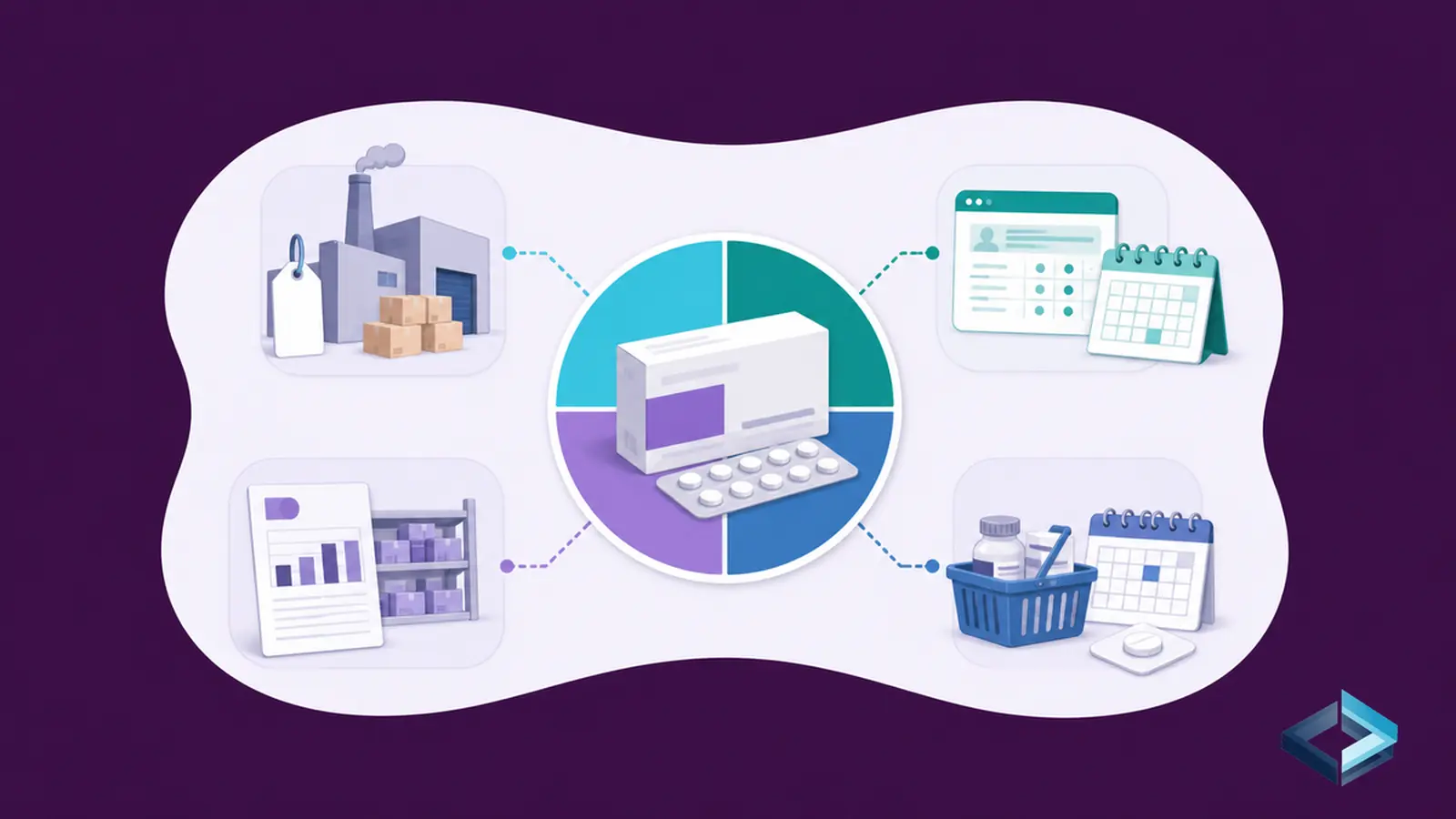
For healthcare data analysts and researchers, WAC ASP AWP drug pricing involves several distinct concepts. Wholesale acquisition cost (WAC), average sales price (ASP), and average wholesale price (AWP) are not interchangeable. They come from different contexts and support different analytical uses. National Average Drug Acquisition Cost (NADAC) provides another public pricing reference.
When interpreting a value, identify what it represents, who published it, which date applies, and what conclusions the record supports. This article compares WAC, ASP, and AWP, then places them alongside NADAC reference data published by the U.S. Centers for Medicare & Medicaid Services (CMS).
Table of contents
- The short answer: WAC, ASP, AWP, and NADAC
- WAC: wholesale acquisition cost
- ASP: average sales price
- AWP: average wholesale price
- How the measures compare
- NADAC provides a different reference point
- Worked example: reading one NADAC record
- Public availability and update cadence differ
- When to use which
The short answer: WAC, ASP, AWP, and NADAC
- WAC is a manufacturer’s list-price concept for a drug sold to wholesalers or other purchasers, before specified discounts or rebates.
- ASP is a sales-based measure used by CMS in Medicare Part B payment methodology. CMS collects quarterly ASP data from manufacturers and publishes payment limits each quarter.
- AWP is a published benchmark found in historical or commercial pricing contexts. It should not be treated as an observed transaction price.
- NADAC is National Average Drug Acquisition Cost reference data. CMS describes its public NADAC dataset as weekly reference data for a calendar year.
One measure cannot automatically substitute for another. Product identifier, package, unit, source, effective period, and intended use all affect interpretation.
WAC: wholesale acquisition cost
Wholesale acquisition cost, or WAC, is a list-price concept associated with a manufacturer’s price for a drug sold to wholesalers or other direct purchasers. It may appear in public or commercial drug-pricing materials.
WAC is not the same as a pharmacy’s acquisition cost, a payer’s reimbursement amount, or a patient’s out-of-pocket price. It is a defined pricing reference, not evidence of the final amount paid in a particular transaction.
When evaluating a WAC value, confirm:
- The product and package described.
- The pricing unit or package size.
- The applicable date or file version.
- How the source defines the field.
Public availability varies. A source that publishes WAC may not publish ASP, AWP, or NADAC in the same file.
ASP: average sales price
Average sales price (ASP) has a specific CMS context in the United States. CMS states that it collects quarterly ASP data from manufacturers through the ASP Data Collection System to calculate payment limits for drugs and biological products.
CMS also states that most separately payable Medicare Part B-covered drugs and biological products have a payment limit of ASP plus 6 percent. CMS publishes payment limits each quarter in the Medicare Part B Payment Limit File. The ASP pricing-file page includes dated files and historical listings, so the applicable quarter and file version matter.
ASP is connected to Medicare Part B payment methodology. It is not another name for a manufacturer list price or a pharmacy acquisition-cost estimate.
CMS also provides specific instructions for seasonal influenza and COVID-19 vaccine pricing. As of August 5, 2026, CMS stated that the 2026–2027 seasonal influenza and COVID-19 vaccine pricing file was available and would be updated periodically as additional pricing information became available. CMS directed external parties to use that file for relevant vaccine pricing and effective dates instead of the quarterly payment-limit file.
This illustrates why source cadence matters: general ASP payment-limit files are published quarterly, while a seasonal file may be updated periodically during the relevant season.
AWP: average wholesale price
Average wholesale price (AWP) is a benchmark used in some drug-pricing references and reimbursement analyses. The term can be misleading if interpreted as a reported market transaction.
AWP should not be treated as an observed transaction price. It does not, by itself, establish what a pharmacy, wholesaler, payer, or patient actually paid. Before drawing conclusions, identify the publisher, date, product, package, and stated methodology.
AWP is not equivalent to WAC. Although both terms contain “wholesale,” they describe different pricing concepts. AWP should also not be substituted for ASP, which CMS uses in a defined Medicare Part B payment context.
Public records for AWP may differ from those for ASP or WAC. Some sources may contain historical AWP references, while others may omit the measure entirely. Availability, revision practices, and update cadence should be checked at the source level.
How the measures compare
| Dimension | WAC | ASP | AWP |
|---|---|---|---|
| Full name | Wholesale acquisition cost | Average sales price | Average wholesale price |
| Basic role | Manufacturer list-price reference | Sales-based measure used in CMS Medicare Part B payment methodology | Pricing benchmark |
| Source context | Manufacturer or drug-pricing reference materials | CMS quarterly manufacturer data and Part B payment-limit files | Public or commercial pricing references, depending on source |
| Transaction meaning | Not automatically a final transaction amount | Used to calculate CMS payment limits; not a patient price | Not an observed transaction price |
| Update context | Varies by publisher and file | CMS publishes payment limits each quarter; some special files may update periodically | Varies by publisher |
| Interchangeable with the others? | No | No | No |
| Key research check | Product, package, unit, and date | Quarter, payment-limit file, product mapping, and effective date | Publisher, methodology, product, package, and date |
This table is a comparison framework, not a universal schema. Every public source does not contain all three measures, and the presence of one does not imply that the others are available.
NADAC provides a different reference point
CMS publishes National Average Drug Acquisition Cost (NADAC) weekly reference data for a calendar year. The Data.gov catalog identifies the publisher as the Centers for Medicare & Medicaid Services within the U.S. Department of Health & Human Services. The catalog entry titled “NADAC (National Average Drug Acquisition Cost) 2026” describes weekly reference data for the calendar year.
As of August 21, 2026, the catalog showed the dataset as last updated on August 18, 2026, and the catalog as last checked on August 21, 2026. These dates describe that catalog listing at that time. Researchers should check the CMS or Medicaid.gov page for current file listings before relying on a particular version.
NADAC is not WAC, ASP, or AWP. Its subject is drug acquisition-cost reference data, while ASP is tied to CMS Medicare Part B payment limits and WAC and AWP serve different reference roles.
QOPE brings selected public healthcare datasets into a more accessible environment. On the Drug Pricing page, available fields include:
- NDC
- Drug name
- NADAC per unit
- Pricing unit
- OTC indicator
- Classification
- Pharmacy type
- Explanation code
- Effective date
- As-of date
These are NADAC-related fields. They should not be read as evidence that WAC, ASP, or AWP are included there.
Worked example: reading one NADAC record
Consider a record organized around NDC, drug name, NADAC per unit, pricing unit, pharmacy type, effective date, and as-of date.
Start with the NDC, or National Drug Code. In this context, it identifies the drug product represented by the record. The identifier helps match a record to a product presentation, but it does not establish a payment amount, approval status, clinical use, or a transaction involving a particular purchaser.
Read drug name, NADAC per unit, and pricing unit together. The price field is expressed according to the stated pricing unit, which matters when comparing products, package sizes, or files. The pharmacy type provides additional classification context and should be retained when grouping or comparing records.
Finally, distinguish effective date from as-of date. The effective date indicates when the value applies within the published reference structure. The as-of date identifies the date associated with the record’s currency or reference status. They answer different questions.
A NADAC record provides structured acquisition-cost reference data for the identified product, expressed through the stated unit and associated dates and categories. It does not turn NADAC into WAC, ASP, or AWP; establish a patient price, a universal amount paid by every pharmacy, or a particular transaction; or replace the official publication. Users should consult the original public source when official verification is required.
Public availability and update cadence differ
A useful comparison requires more than matching column names. CMS identifies quarterly collection and publication for Medicare Part B payment limits, while the NADAC catalog describes weekly reference data for each calendar year. CMS also notes that its 2026–2027 seasonal vaccine pricing file may be updated periodically.
WAC and AWP availability depends on the source. A source may publish one measure, several measures, historical files, or none of them. Capture file names, effective dates, revisions, and methodology notes alongside each value.
When to use which
Use WAC when the analysis requires a manufacturer list-price reference and the source clearly defines the product, package, unit, and date.
Use ASP when studying CMS Medicare Part B payment limits or related quarterly pricing files. Preserve the quarter, file version, and effective dates.
Use AWP when a source explicitly provides the benchmark and its methodology fits the research question. Do not present it as an observed transaction price.
Use NADAC when the question concerns National Average Drug Acquisition Cost reference data, including product identifiers, pricing unit, pharmacy type, effective date, and as-of date. For a structured way to explore those fields, visit QOPE’s Drug Pricing page.
Explore drug pricing records in QOPE
QOPE is not affiliated with CMS, the FDA, or any government agency. QOPE organizes selected public healthcare data and does not replace official sources.